
Monday morning starts with a familiar problem. You wipe the storefront door before opening, yet the glass still looks hazy. Fingerprints collect around the pull handle, salt film clings to the lower panel after a coastal night, and a faint draft slips beneath the threshold. You may be wondering whether you’re dealing with a cleaning issue, a worn door sweep, damaged glass, or all three.
Commercial storefront glass doors are systems, not isolated panes. The door leaf, glass, aluminum frame, pivots, closer, latch, threshold, weatherstripping, and surrounding sidelites must work together. A visually attractive entrance can still create daily trouble if the hardware is undersized, the glass specification is wrong, or the frame allows air and water into the opening.
This guide approaches the entrance the way a building-code-aware contractor would explain it to a new shop owner. You’ll learn how door format, glass type, frame construction, cleaning habits, and inspection requirements connect, with practical help for deciding what matters every day and what matters when an inspector or replacement contractor reviews the assembly.
Table of Contents
- What Every Storefront Owner Should Know Before Anything Else
- The Main Door Types and How They Handle Daily Traffic
- Glass Options Beyond a Single Pane of Clear Glass
- Frame and Hardware Choices That Carry the Glass
- Cleaning and Maintenance Habits That Actually Stick
- Safety Glazing and Building Code Basics
- Accessibility, Security, and Energy Performance in One View
- Putting It All Together with a Simple Care Checklist
What Every Storefront Owner Should Know Before Anything Else
Start by separating surface appearance from system performance. Streaks may come from cleaner residue or poor squeegee technique, but a persistent haze can also signal mineral deposits, coating damage, or failure inside an insulated glass unit. A door that looks dirty isn’t automatically defective, and a door that looks polished isn’t automatically safe or compliant.
Daily wear usually appears in predictable places:
- At the handle or push bar: Hands leave oils and fingerprints where customers naturally grip or push.
- Along the lower glass and frame: Shoes, carts, dust, and street residue concentrate near the walking surface.
- At the threshold: Grit can interfere with weather seals, collect moisture, and increase resistance during operation.
- Around hinges, pivots, and closers: Misalignment gradually shows up as rubbing, slow closing, latch failure, or a door that doesn’t sit square.
- At the perimeter: Worn sweeps and gaskets allow drafts, rain, and fine dust into the entry.
For a new owner, three decisions shape nearly everything else: door type, glass specification, and frame style. A swinging door needs different clearance and hardware from a sliding unit. A clear tempered pane behaves differently after impact from laminated glass. A narrow-stile aluminum system is serviced differently from a heavy-glass frameless assembly.
Practical rule: If a cleaning problem keeps returning in the same location, inspect the component behind it instead of repeatedly applying more cleaner.
Local building requirements and accessibility rules influence these choices. They may not be obvious during a product search, but they become important when the entrance is inspected, repaired, or altered. A useful commercial cleaning routine therefore includes more than bright glass. It also keeps safety markings visible, thresholds clear, hardware usable, and seals easy to evaluate. For planning costs around recurring service, compare the factors discussed in this commercial window cleaning pricing guide.
The Main Door Types and How They Handle Daily Traffic
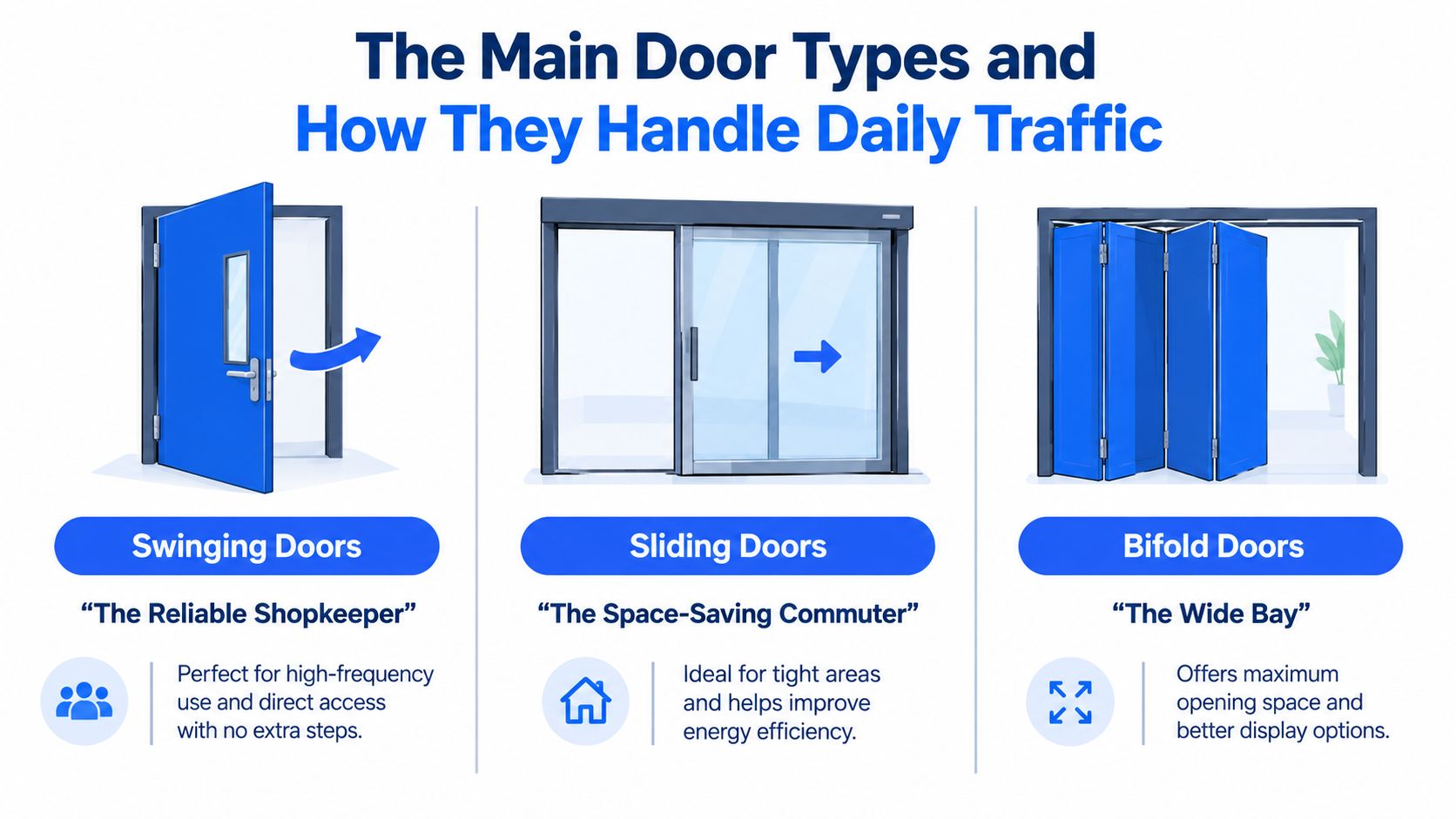
A swinging door is the reliable shopkeeper. It opens directly, closes behind the customer, and works well where people approach from a predictable direction. Single-direction operation can suit a narrow entry, while paired leaves provide a broader passage. The tradeoff is swing clearance. Customers, displays, queues, and sidewalk space all need to stay out of the door’s path.
A sliding door is the space-saving commuter. Its panels travel along a track rather than projecting into the approach area, which can help where carts, queues, or limited floor space make a swinging arc inconvenient. The track, rollers, sensors, seals, and closing controls need regular attention, especially where grit or salt can collect. A sliding system may also require careful coordination between automatic operation, emergency egress, and accessibility requirements.
A bifold door is the wide bay. Folding leaves can open a large section of the frontage when a restaurant, showroom, or hospitality space wants a stronger connection to the sidewalk. That broad opening comes with more hinges, carriers, seals, and moving joints. Wind exposure and panel alignment matter because the system has more parts that must remain synchronized.
Match the format to the entrance
Think about how people arrive. A small service shop with one customer at a time may favor a manual swing door. A busy retail entrance with carts may benefit from a sliding arrangement if the building layout supports it. A café with a seasonal open frontage may accept the added adjustment and weather-seal work of a bifold system.
Wind changes the calculation. Swinging leaves receive direct pressure at the hinges and closer. Sliding panels transfer forces through tracks and guides. Bifold leaves distribute movement across several connected sections. In every case, the glass must suit the moving panel, and larger or impact-exposed panels commonly lead specifiers toward tempered or laminated safety glazing.
Door operation also intersects with building security. If you need controlled entry, alarms, monitoring, or electronic release, review the system as a whole rather than adding a lock after installation. A resource covering integrated security for commercial door entry can help property teams think through access control alongside the physical door format.
Glass Options Beyond a Single Pane of Clear Glass
Clear glass describes appearance, not performance. The important question is what the pane does when exposed to impact, heat movement, sound, forced entry, and daily cleaning.
Annealed glass is ordinary float glass. It can offer a clean, familiar view, but it breaks into sharp shards and generally isn’t the right specification for a door or nearby hazardous location. It may appear in nonhazardous fixed glazing, subject to the project requirements, but replacing safety glass with annealed glass is a serious mistake.
Tempered glass is heat-treated for safety performance. When it breaks, it fragments into small pieces rather than large knife-like shards. The National Glass Association describes heavy glass doors as intended to meet ANSI Z97.1 unlimited class and CPSC 16 CFR 1201 Category II requirements, with Category II tied to a 400 foot-pound impact test in the cited guidance from the National Glass Association heavy glass door manual.
Laminated glass uses bonded layers that can hold fragments together after breakage. That can support security, sound control, and occupant protection, though the assembly may be heavier and require hardware designed for the added load. It often makes sense where the entrance faces a noisy street or where forced-entry resistance matters.
Insulated glass units, or IGUs, combine separated panes with a sealed cavity. They can improve thermal performance and reduce interior-surface condensation, but the door frame, spacer, seals, and threshold still need to control air and water movement. An IGU won’t correct a poorly aligned door.
| Glass Type | Safety Behavior | Sound & Energy | Typical Use |
|---|---|---|---|
| Annealed | Breaks into sharp shards and commonly isn’t suitable for door glazing | Basic visual performance, limited protective value | Nonhazardous fixed areas when permitted |
| Tempered | Fragments into small pieces after breakage | Clear view and strong safety baseline, with limited post-breakage retention | Many swinging and sliding door leaves |
| Laminated | Holds bonded fragments together after impact | Supports sound reduction and security, with added weight | Security-focused, noisy, or higher-abuse entrances |
| Insulated glass unit | Performance depends on the complete sealed assembly | Helps thermal control and condensation management | Energy-conscious storefront systems where frame and hardware support it |
The final choice balances clarity, safety, sound, security, and weight. The glass that looks best in a sample may not be the glass your pivots, frame, climate, or code path can support.
Frame and Hardware Choices That Carry the Glass
Most owners choose between an aluminum narrow-stile system and a heavy-glass frameless door. The first uses aluminum rails and stiles to support the pane. The second shifts more responsibility to thick glass, top and bottom fittings, patch hardware, pivots, and carefully installed anchors.
Commercial storefront entrance systems are commonly built around narrow-stile aluminum assemblies with framing depths from about 2 to 4-1/2 inches, according to published storefront entrance specification guidance. The same source notes that a 3 by 7 foot, 1-3/4 inch tempered heavy-glass door can weigh roughly 125 to 135 pounds, so pivots and closers must be selected for more than the door’s static weight.
That load affects everyday behavior. Undersized or poorly adjusted hardware can cause sagging, latch misalignment, slow closing, and repeated service calls. Exterior frames also need to account for wind and deflection. The cited guidance discusses storefront support limits on the order of L/175 under design wind load, which is why taller or wider openings may need deeper sections or reinforcement.
Compare the two frame paths
| Attribute | Aluminum Narrow-Stile | Heavy-Glass Frameless |
|---|---|---|
| Visual character | Defined vertical and horizontal aluminum lines | Minimal framing and a cleaner glass-forward appearance |
| Glass support | Frame carries and protects the glass edges | Patch fittings and glass hardware carry the operating loads |
| Service approach | Often simpler to adjust and re-glaze | Requires precise fitting, alignment, and specialized hardware |
| Hardware demand | Hinges, closers, pivots, and rails integrate with the frame | Pivots, patch fittings, rails, and anchors must be coordinated closely |
| Finish options | Clear anodized, bronze anodized, or painted finishes | Hardware finish becomes a major visual element |
| Weather control | Gaskets, rails, sweeps, and frame details manage the perimeter | Seals and bottom details require careful installation and adjustment |
Clear anodized aluminum offers a restrained appearance, bronze anodized finishes add warmth, and painted frames support stronger color coordination. A thermal break can improve the frame’s resistance to heat transfer, but it won’t compensate for a damaged sweep or an open threshold gap.
For busy shops, narrow-stile doors are generally easier to service and replace after breakage. Frameless doors can deliver a premium appearance, but their cleaner look comes with less tolerance for installation errors and more expensive specialized hardware.
Cleaning and Maintenance Habits That Actually Stick
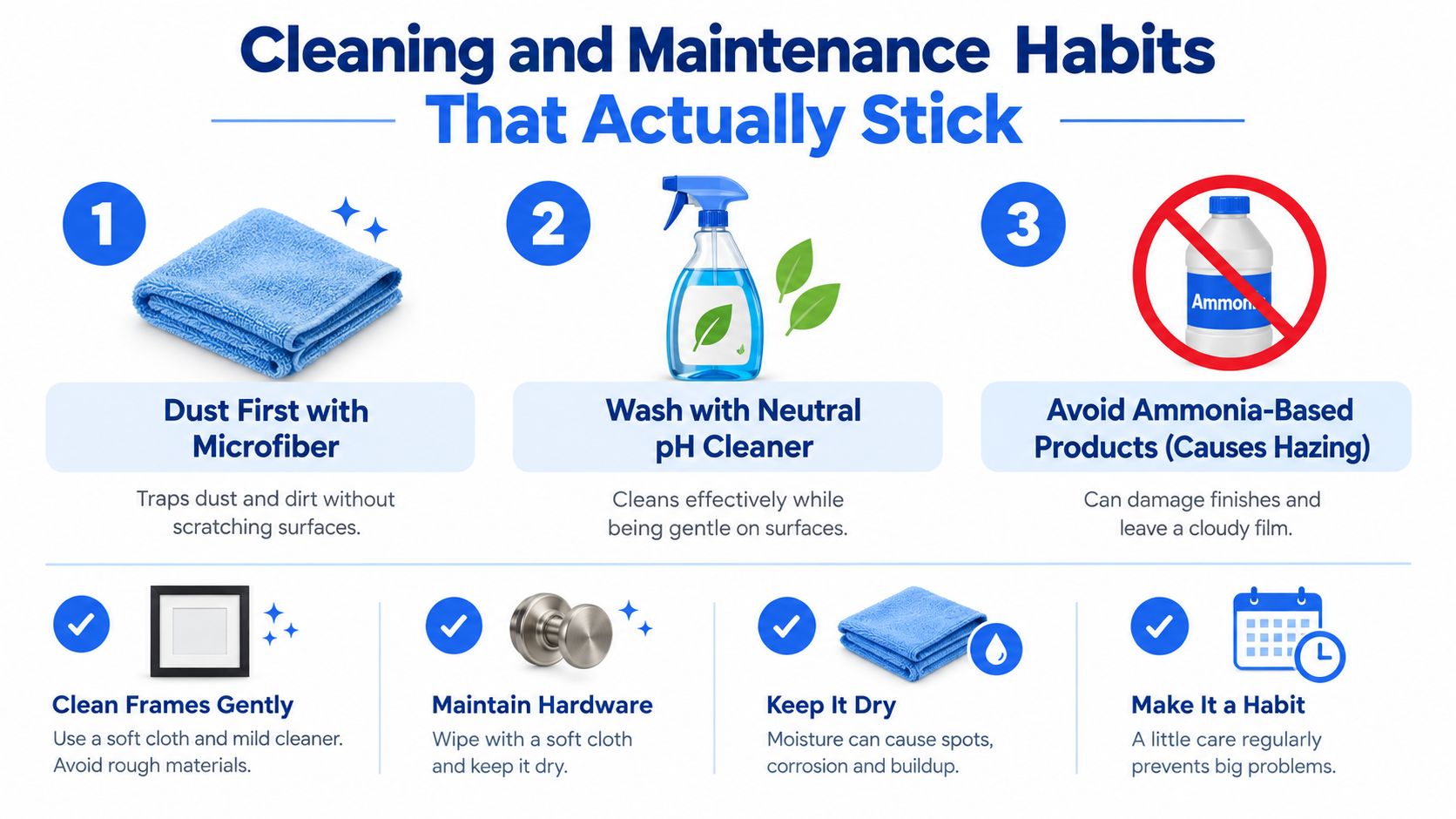
A durable cleaning routine starts with the least aggressive method. Remove loose dust with a clean microfiber cloth before applying liquid, then use a neutral pH glass cleaner and a clean squeegee. Spraying onto the cloth instead of flooding the door helps keep liquid away from pivots, locks, sensors, and edge seals.
Ammonia-based products can damage low-emissivity coatings and contribute to gasket deterioration. If the glass keeps streaking, the cleaner may be leaving residue, the squeegee blade may be dirty, or the operator may be dragging grit across the pane. Practical product-handling ideas are also covered in these glass cleaner spray tips from Evo Dyne Products.
Clean each material differently
Use mild soap, clean water, and a soft cloth on anodized aluminum. Avoid abrasive pads, powdered cleaners, and aggressive scraping. Painted frames can be wiped with the same gentle approach, but watch for chalking, fading, or exposed areas where corrosion can begin.
Tracks and thresholds deserve their own pass. Vacuum loose grit before wiping. Salt crystals and sand can grind against rollers, block drainage, and increase the effort required from closers or operators.
- Coastal locations: Rinse salt residue with fresh water, then dry metal and hardware rather than allowing salty moisture to remain.
- Inland dusty locations: Vacuum tracks more often during windy, dusty periods so grit doesn’t become embedded in rollers or seals.
- Hard-water areas: Remove mineral deposits with a method approved for the glass and frame finish, avoiding contact with vulnerable hardware.
For a broader approach to storefront glass and surrounding surfaces, use this guide to commercial storefront window cleaning as a companion reference.
A simple cadence works better than occasional intensive cleaning:
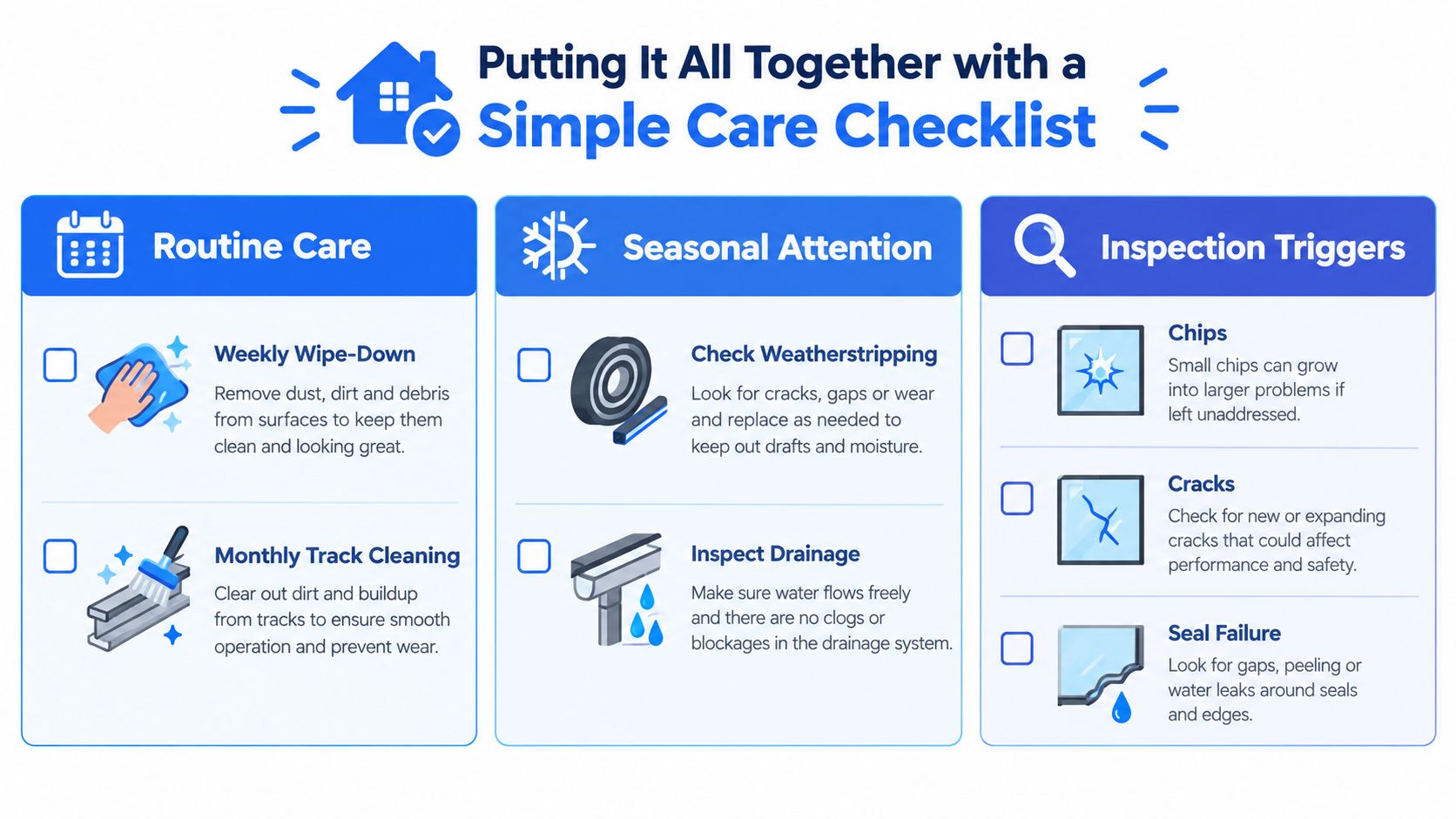
- Weekly: Wipe both glass surfaces, handles, push bars, and visible frame areas. Check that the latch engages.
- Monthly: Vacuum tracks, clean thresholds, inspect sweeps and gaskets, and look for loose or shifting hardware.
- Seasonally: Check drainage, weather seals, corrosion, and wind-related movement after storms or high-wind periods.
The following video provides a visual reminder of basic care practices. Use it as a supplement to the manufacturer’s maintenance instructions.
Safety Glazing and Building Code Basics
A storefront door sits directly in a pedestrian path, so building codes treat its glass as a hazardous location. Under the International Building Code framework, IBC Chapter 24 addresses glass and glazing, including doors and nearby panels. Safety glazing is required in locations such as doors and glazing within 24 inches of a door edge and less than 60 inches above the walking surface, as summarized in this IBC glazing code reference.
The rule can apply to more than the moving door leaf. Fixed sidelites close to the opening and low panels near the walking path may also fall within the regulated zone. A transom or other panel above the door can require review when its location places it within the relevant height and impact area.
Federal requirements distinguish impact levels. CPSC 16 CFR 1201 Category I uses a 150 foot-pound impact test, while Category II uses a 400 foot-pound impact test. The cited code guidance also states that glass panels larger than 9 square feet in door-related hazardous locations must meet Category II requirements under the referenced federal glazing standard summary.
What owners should verify after damage
Don’t let a quick replacement create a larger compliance problem. Ordinary annealed glass may fit the opening and look clear, but it doesn’t provide the required safety behavior for a regulated door location. A temporary plastic substitute also needs review rather than assumption, because material, labeling, fire requirements, and local approval can all affect whether it is acceptable.
Look for the permanent safety-glazing mark, often etched or ceramic-fired into the pane. It should identify the applicable standard or certification. If a logo or decorative mark is being added to tempered glass, coordinate the process before fabrication because post-tempering alteration can compromise the required marking or the glass itself.
A cracked pane, damaged edge, missing label, or replacement of unknown specification warrants a professional evaluation. Schools, high-abuse retail spaces, and other exposed occupancies may need impact-rated or security-focused options beyond the basic safety-glazing baseline.
Accessibility, Security, and Energy Performance in One View
Entrance decisions work better when accessibility, security, and energy performance are reviewed together. A door that is difficult to open can frustrate customers and staff even if its lock is strong. A secure pane that adds weight may require a closer, pivot, or automatic operator capable of handling that load. A thermally improved frame still performs poorly if the threshold leaks air.
Begin with the public path. Review maneuvering clearance, threshold transitions, door opening force, and operable hardware with the applicable accessibility professional or authority having jurisdiction. Handles, panic devices, push plates, electronic releases, and automatic operators must be placed and selected so people can use the entrance without excessive force or awkward reach.
Security comes next. Laminated glass can retain fragments after impact, while access-control components can regulate who enters. Cameras need a clear sightline to the approach, lock, and handle area. Frameless doors may look uninterrupted, but their patch fittings and lock locations require careful coordination. For a practical discussion of door access choices for property managers, review the access-control components before selecting the final hardware package.
Thermal performance depends on the complete opening. U-factor addresses heat transfer, SHGC addresses solar heat gain, and air leakage depends heavily on perimeter seals, sweeps, thresholds, and installation quality. Insulated glazing, thermal breaks, warm-edge spacers, and sound weatherstripping can support comfort, but local energy requirements vary by climate zone and compliance path, so the design team must verify the applicable criteria. Industry coverage also describes growing use of laminated and bullet-resistant storefront glazing for security, while emphasizing that energy decisions still need separate code review in this security glazing discussion.
| Priority Area | Code or Standard | Storefront Door Implication | Common Tradeoff |
|---|---|---|---|
| Accessibility | Applicable accessibility requirements | Clearance, threshold, force, and hardware must support independent use | A heavier security assembly may need stronger operating assistance |
| Life safety | Safety-glazing rules and egress requirements | Glass and panic hardware must suit the occupancy and exit path | Decorative or security upgrades can’t replace compliant egress hardware |
| Security | Project security criteria and access-control design | Laminated glass, locks, strikes, sensors, and cameras must work as one system | Maximum transparency can reduce privacy and make hardware coordination harder |
| Energy | Local energy code and chosen compliance path | Frame, glass, seals, and threshold must limit unwanted heat transfer and leakage | Higher-performance assemblies can increase upfront complexity |
When money is tight, don’t cut the components that protect access, egress, or glazing safety. Cosmetic frame finishes can wait more easily than a correctly rated closer, a usable threshold, a compliant safety pane, or a perimeter seal that keeps rain outside.
Putting It All Together with a Simple Care Checklist
Treat the entrance as a small maintenance program, not a last-minute cleaning task. Clear glass makes cracks and edge damage easier to spot. A clean threshold makes water pooling visible. Legible safety markings help a contractor identify the replacement specification before ordering a pane.
Weekly care
- Wipe the glass: Remove fingerprints, salt film, dust, and cleaner residue with microfiber and an approved neutral pH product.
- Clean contact points: Wipe handles, push bars, and nearby frame sections where oils accumulate.
- Check the latch: Confirm that the leaf closes fully and engages without slamming, dragging, or repeated attempts.
- Scan the lower edge: Look for chips, cracks, loose gaskets, and grit around the threshold.
Monthly attention
- Vacuum the track: Sliding and bifold systems need loose grit removed before it reaches rollers or guides.
- Inspect weatherstripping: Look for compression, splitting, gaps, or sections that have pulled away.
- Review hardware: Check visible fasteners, pivot covers, closer arms, and signs of sagging or rubbing.
- Clear drainage paths: Remove debris so water doesn’t remain against aluminum or seals.
Seasonal and annual review
Coastal entrances need more frequent freshwater rinsing and corrosion checks. High-dust areas need closer attention to tracks, thresholds, and lower frame channels, particularly after windy weather.
At least annually, arrange a fuller review of the glazing, hardware, accessibility features, panic operation where applicable, and perimeter seals. Confirm that safety markings remain readable and that any insulated unit hasn’t developed fogging between panes. For a professional service routine that includes detailed commercial surfaces, compare a commercial window cleaning company service with your in-house checklist.
Call a qualified contractor promptly if the door won’t latch, the glass fogs between panes, water pools at the threshold, the panel drags, the closer slams, or the safety-glazing marking becomes unreadable. Also stop treating a damaged pane as a cosmetic issue. A cracked or incorrectly replaced lite can affect occupant safety, inspection readiness, and the performance of the entire entrance.
If your storefront needs clearer glass, cleaner frames and tracks, or a closer look at salt, dust, and buildup around the entrance, Aloha Window Bros provides professional commercial window, screen, frame, and sill cleaning in Ventura County and Santa Barbara County. Request a free on-site quote and make your storefront maintenance routine support both a welcoming appearance and easier compliance checks.