

You open the shop in Ventura before the first customers arrive and immediately notice the storefront looks tired. The glass was cleaned last week, but it still has a dull film, sprinkler spots, or streaks that catch the morning light. You wipe one pane with a towel and discover the problem isn’t just dirt. The frame is collecting grime, the lower seal looks brittle, and one insulated panel has a faint haze between the panes.
That’s the common mistake with commercial storefront windows. Owners treat them as a surface to wash, while the building relies on them as its public face, daylight source, thermal barrier, and part of the weather envelope. A reliable program has to connect glass performance, coastal exposure, cleaning rhythm, and inspection quality.
The U.S. commercial and multifamily building stock contains approximately 21 billion square feet of glass vision area, including about 14 billion square feet in commercial and institutional properties, according to the Commercial Building Fenestration Market Study prepared by Guidehouse for the National Fenestration Rating Council (August 2021). Storefront systems are included alongside curtain wall and punched windows, which means this isn’t a niche maintenance concern. It’s a recurring operating issue across retail, restaurants, healthcare, education, offices, and other public buildings.
Table of Contents
- Why Storefront Windows Deserve More Attention
- Main Storefront Window Types and How They Differ
- Coastal Climate Threats to Storefront Glass
- Cleaning and Inspection Schedules That Work
- What a Commercial Window Service Should Deliver
- Storefront Windows as Part of the Building Envelope
- A Simple Checklist for Property Managers
Why Storefront Windows Deserve More Attention
A storefront does several jobs at once. It presents merchandise, admits daylight, separates conditioned space from the outdoors, resists wind and rain, and helps control indoor comfort. When a property manager assigns only a quick glass wipe-down, most of that system receives no attention.
A dull pane can reduce visual impact before anyone notices a technical failure. Customers see a tired entrance, while the building owner may be dealing with degraded sealant, blocked drainage paths, corroded aluminum, or a film that ordinary soap can’t remove. The glass may look acceptable from across the sidewalk and still deserve a closer inspection at the perimeter.
The installed base makes small failures expensive
Modern storefront glazing became practical because industrial flat-glass manufacturing replaced scarce, handmade panes. Sir Alastair Pilkington’s float glass process, introduced commercially in 1959, became the global standard for flat glass and made large, distortion-free storefront panes affordable.
That history matters because today’s transparent commercial frontage is ordinary only because production, framing, and installation became scalable. A small maintenance failure now affects a standard component of a very large built environment.
Practical rule: If your window contractor only talks about shine, you haven’t had a building-envelope conversation yet.
What your current program probably misses
Most storefront cleaning programs are reactive. Someone complains about fingerprints, a tenant requests service before an inspection, or a manager schedules a visit after the glass becomes embarrassing. That approach misses the slow problems that lead to replacement work.
A better program asks four questions:
- What is the glass made of? Single-pane plate glass and insulated units don’t respond the same way to heat, moisture, and contamination.
- What is the exposure? A beachfront restaurant, an inland sidewalk shop, and an interior mall entrance have different maintenance demands.
- What is being inspected? The crew should examine seals, frames, sills, tracks, weep holes, hardware, and film, not just the visible pane.
- What gets documented? Photos and condition notes give you a record before a tenant buildout, lease renewal, or replacement decision.
The blunt recommendation is simple. Put commercial storefront windows on a planned maintenance calendar, not a complaint list.
Main Storefront Window Types and How They Differ
Start by identifying the existing system before you price cleaning, restoration, or replacement. Property managers often call every large glass opening a storefront, but fixed plate glass, insulated units, safety glass, and curtain wall assemblies have different failure points and different repair paths.
Fixed plate glass
Older downtown buildings in Ventura and Santa Barbara often contain single-pane fixed glass set in aluminum framing. It offers clear visibility and straightforward replacement, but it provides less thermal separation than an insulated glass unit. Coastal salt film also shows quickly on broad, flat panes, and mineral spotting can become difficult to remove if irrigation repeatedly reaches the lower glass.
Tempered glass is heat-treated for safety and is common in doors and high-use areas. It resists ordinary impact better than untreated glass, but it can still scratch, stain, or fail after a severe impact. Laminated glass uses an interlayer that holds the glass together when cracked, making it useful where safety, security, or sound control matters.
Insulated glass units
An IGU uses separate panes divided by a spacer and sealed around the edge. It can improve thermal performance, especially when paired with Low-E coatings, but the sealed cavity creates a distinct failure mode. A broken perimeter seal can produce fogging or moisture between panes. Exterior cleaning won’t remove that haze because the contamination is inside the unit.
The replacement process also requires accurate measurements, compatible glazing materials, and careful handling. Don’t approve a replacement based only on visible pane size. Record the unit dimensions, glass markings, tint or coating, spacer appearance, and frame pocket before ordering.
Storefront framing and curtain wall
Aluminum storefront is typically a lower-rise, sill-supported system assembled in field-installed sections. Curtain wall is a more substantial, multi-level façade system that transfers loads through a larger framing grid. Stick-built curtain wall arrives as components assembled on site, while other systems use more factory-assembled units.
Curtain wall can offer stronger weather and thermal strategies, but repairs may involve more specialized access and coordination. Storefront work is often simpler, yet poor sealant, blocked weep holes, and frame corrosion still create real water-management problems.
| Type | Typical Use | Strengths | Watch Out For |
|---|---|---|---|
| Single-pane plate glass | Older retail and low-rise frontage | Simple appearance and direct replacement path | Lower thermal separation, salt film, mineral etching |
| Tempered glass | Doors, sidelites, and high-use openings | Safety-oriented break pattern and common availability | Scratches, impact damage, difficult field modification |
| Laminated glass | Security, safety, or sound-sensitive areas | Interlayer holds cracked glass together | Edge exposure and replacement compatibility |
| Insulated glass unit | Newer energy-conscious storefronts | Better thermal strategy when properly specified | Failed seals, interior fogging, measurement-sensitive replacement |
| Aluminum storefront | Retail, restaurants, offices, and entrances | Accessible, modular, familiar to contractors | Sealant, drainage, corrosion, and hardware maintenance |
| Curtain wall | Larger or taller glazed façades | More substantial façade design and weather strategy | More complex access, joints, and replacement coordination |
Before hiring a service company, photograph the exterior and interior, mark fogged or cracked units, note door and frame locations, and ask whether the system is storefront or curtain wall. That basic record prevents a cleaner, glazier, and property manager from solving three different problems under one vague work order.
Coastal Climate Threats to Storefront Glass
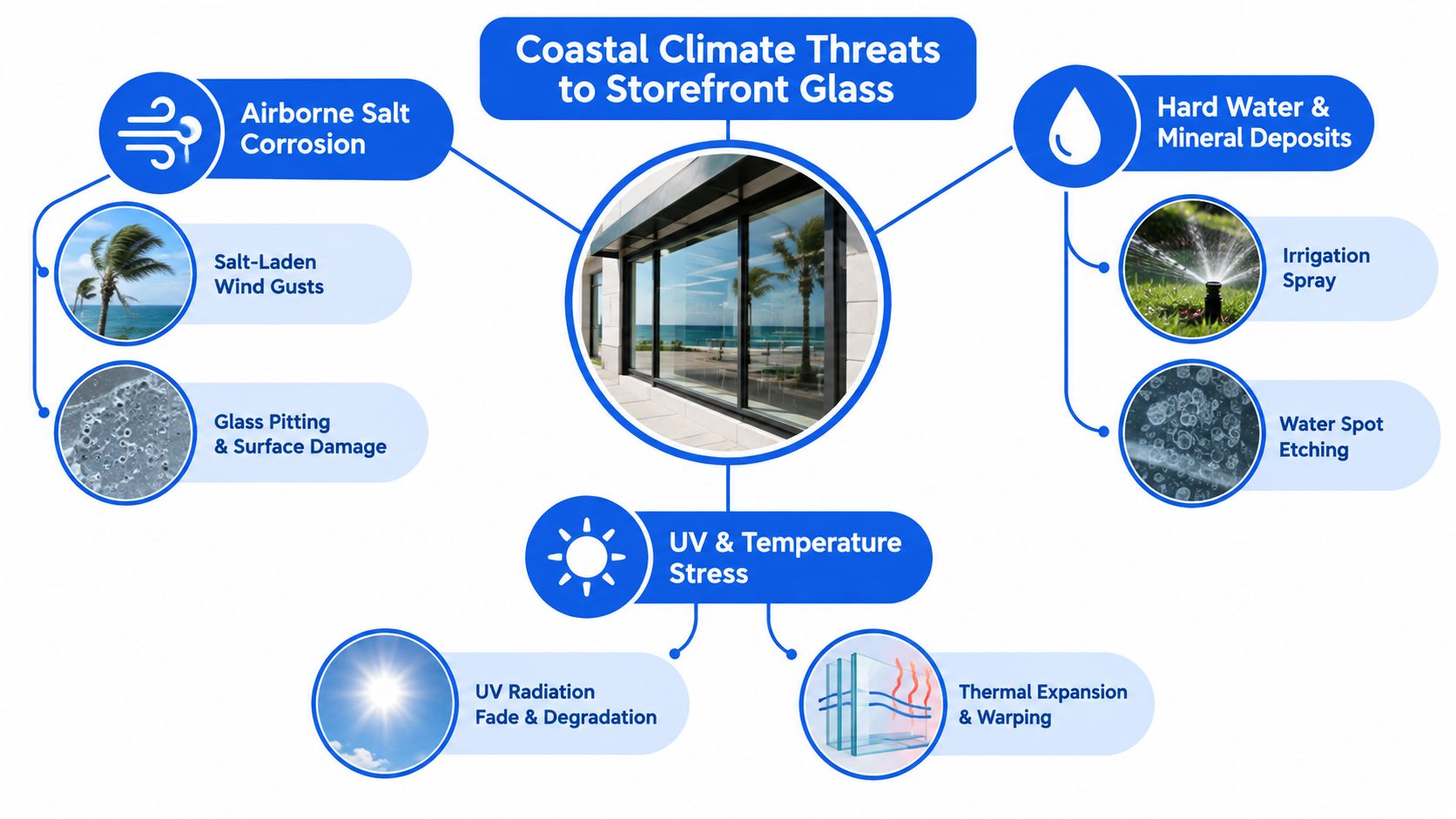
A storefront in Ventura or Santa Barbara can look clean from the sidewalk while salt, minerals, dust, and ultraviolet exposure reduce performance. Onshore air leaves salt on exposed corners, irrigation wets lower panes, dry winds carry grit and pollen, and UV exposure ages sealants and films. The glass gradually transmits less daylight, while frames, gaskets, weep paths, and perimeter joints deteriorate out of sight.
That matters beyond appearance. A window’s U-factor describes heat flow, while SHGC describes how much solar heat enters. Surface contamination does not change the original rating on paper, but it can reduce useful daylight and alter how the storefront performs in daily operation. Your cleaner should inspect the glass, frame condition, drainage, sealants, and water sources, not just wipe the pane.
Salt residue is most troublesome near the coast and around exposed corners. After water evaporates, crystals remain and can contribute to pitting or etching. Routine washing removes loose residue. Hardened deposits need a method suited to the glass condition. Aggressive scraping is poor diagnosis and can scratch the pane.
What the symptoms are telling you
Irrigation overspray and runoff leave mineral deposits that bond to glass. Retail centers with sprinklers aimed toward the façade see this often. Tree pollen and organic debris form a stubborn film when moisture holds residue against the pane before the sun dries it.
Look for these clues:
- Persistent haze: Cloudiness after ordinary cleaning can indicate etching, contamination buildup, or a failed IGU seal.
- White spotting: Repeating circles or trails near lower edges usually point to sprinkler overspray or runoff.
- Frame discoloration: White, chalky deposits or dark corrosion near joints should be addressed before the material weakens.
- Streaks at corners: Salt, dust, and water collect where wind and drainage concentrate them.
- Interior fogging: Moisture between panes indicates a sealed-unit problem, not a dirty exterior.
Contamination also reduces transmitted light, the same property ENERGY STAR measures as visible transmittance (covered below). Clear glass supports daylight, merchandise visibility, and the condition customers associate with the business.
Exposure should set the schedule
An oceanfront storefront, a busy restaurant entrance, and an inland shop surrounded by landscaping require different service intervals. In Camarillo and Ojai, hard-water exposure may outweigh salt. An exposed Santa Barbara or Ventura frontage can collect salt and windborne grit quickly.
Have the cleaner identify the contamination source, then inspect sprinklers, runoff paths, sealant, frame joints, drainage openings, and door hardware. Correct the water source when possible. If haze remains after appropriate cleaning, stop increasing chemical strength and have the surface or IGU assessed.
Cleaning and Inspection Schedules That Work
A generic monthly plan is easy to manage and often wrong. Set the cadence by exposure, customer traffic, visibility standards, and the contamination reaching the façade. In Ventura and Santa Barbara, salt air, windborne grit, and irrigation runoff can change the workload quickly.
A beachfront restaurant or exposed ground-floor business needs closer attention than a sheltered interior storefront. Busy entrances collect fingerprints, grease, and door-edge grime faster than quiet offices. Weekly or biweekly cleaning may suit high-traffic locations, while lower-traffic properties can often use monthly or quarterly service.
Match service to the property
| Location Type | Exterior Cleaning | Interior Cleaning | Inspection Checkpoints |
|---|---|---|---|
| Beachfront or exposed restaurant | Biweekly, with spot checks after heavy exposure | Frequent touch-up at doors and customer-contact areas | Salt film, lower-edge deposits, sealant, frame corrosion, door hardware |
| In-town sidewalk retail | Monthly, adjusted for traffic and dust | Quarterly, plus fingerprints and display changes | Perimeter seals, scratches, water staining, tracks, film condition |
| Interior mall or sheltered storefront | Quarterly to semi-annually | Quarterly to semi-annually | Frame joints, sill drainage, glazing beads, door alignment |
| Inland property near active irrigation | Based on spotting and runoff | Routine tenant-area service | Sprinkler overspray, mineral deposits, weep holes, sealant |
Every visit should include a quick system inspection. Cleaners should check sealant joints, perimeter gaskets, frame corrosion, water staining, misalignment, weep holes, tracks, sills, and peeling tint or film. Inspect the door closers, pivots, locks, and thresholds as well. A pane can look clear while drainage or hardware problems continue behind the cleaning work. An annual ground-level survey of the whole façade, with closer attention on busy entrances, catches most of these before they become repairs.
Deal with mineral deposits early
In Camarillo and Ojai, irrigation overspray creates a repeatable spotting pattern. Calcium and other minerals remain after water dries, and repeated deposits can etch the surface. Correct the sprinkler or runoff source before the glass becomes permanently cloudy.
Purified-water methods can reduce residue during routine service. A guide to purified water window cleaning explains why treated water can leave less mineral residue than ordinary tap water.
Scheduling rule: Clean before you inspect, inspect before you replace.
For property managers, that sequence prevents two expensive errors. Removable contamination will not be mistaken for failed glass, and a cleaner will not polish a pane while ignoring a seal, frame, drainage, or hardware problem that will return.
What a Commercial Window Service Should Deliver
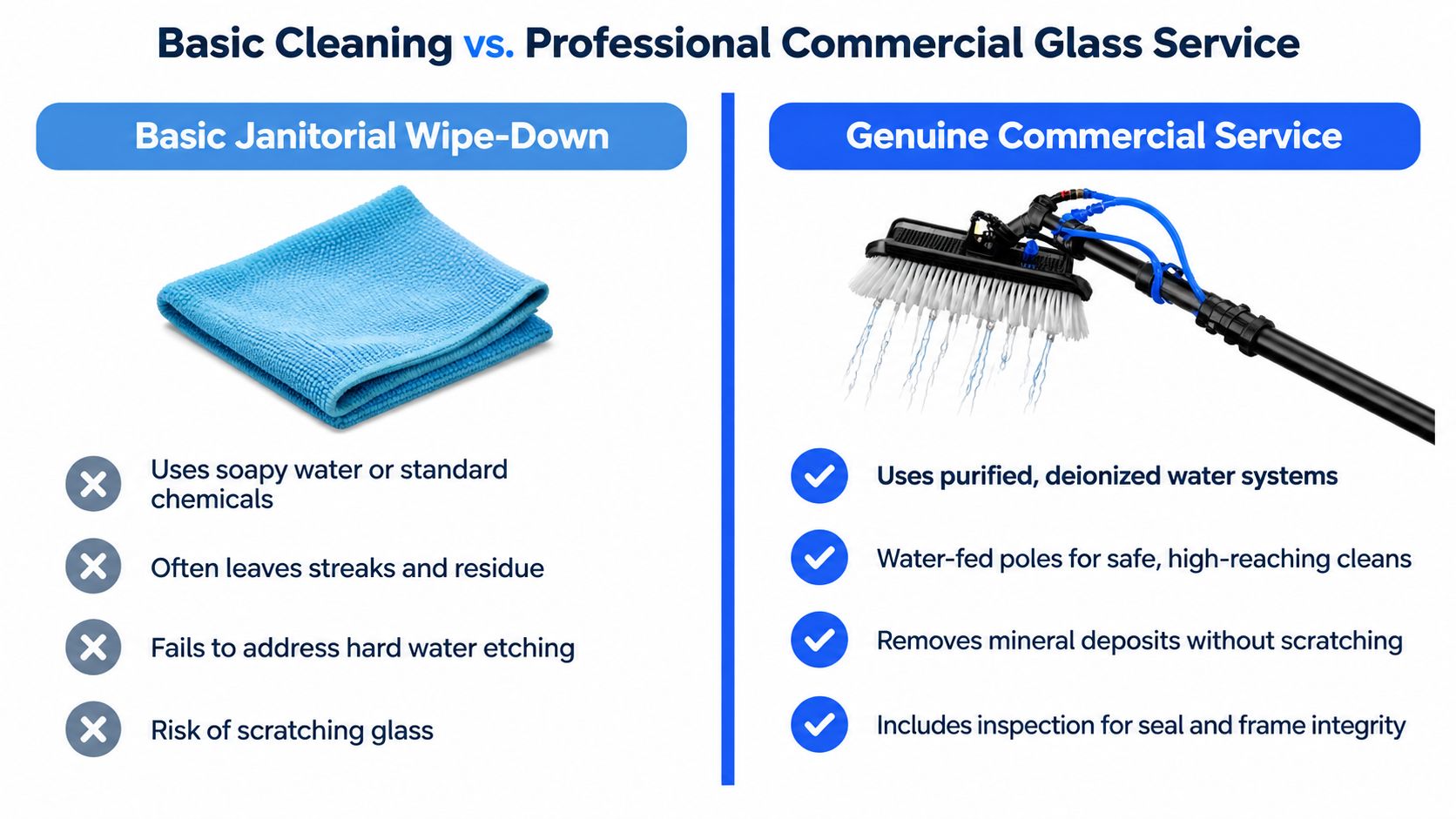
A basic janitorial wipe-down and a genuine commercial glass service aren’t the same purchase. One improves the visible surface for the day. The other should clean the glazing system and report conditions that affect safety, appearance, drainage, and future repair.
A capable crew may use water-fed poles and purified-water systems for higher panes, along with appropriate tools for interior glass, frames, tracks, and sills. The exact equipment should match the building, but a bucket of soapy water and a quick pass over the pane isn’t enough for a storefront exposed to coastal residue.
Compare the scope before comparing price
A low-cost visit may cover fingerprints and obvious streaks. It may not include frame detailing, mineral-deposit treatment, sealant observations, or documentation. A more complete commercial quote should define the panes, doors, sidelites, transoms, frames, sills, tracks, screens, access equipment, and reporting included.
Ask for a written service report containing:
- Condition photographs: Before-and-after images of representative elevations and problem areas.
- Frame notes: Corrosion, staining, loose components, damaged finishes, and sill condition.
- Seal observations: Cracked sealant, separated gaskets, failed glazing beads, or visible perimeter gaps.
- Glass flags: Cracked, scratched, etched, fogged, or otherwise compromised lites.
- Access and safety details: Ladder, lift, water-fed pole, or other equipment used for work at height.
- Completion confirmation: Areas serviced, exclusions, and issues requiring a glazier or envelope contractor.
Safety and accountability belong in the quote
Two-story Ventura storefronts create access and liability questions. Verify that the company carries liability insurance and uses appropriate ladder or lift practices consistent with OSHA requirements. Don’t let a low bid hide unsafe access, unprotected merchandise, or a crew that cannot explain how it will reach the glass.
A handyman’s per-visit price and a commercial provider’s per-pane quote are not automatically comparable scopes. The important question is what each price includes, who carries the risk, and whether the work maintains only the glass or the surrounding glazing system.
For a broader service-scope reference, review this guide to choosing a commercial window cleaning company.
Storefront Windows as Part of the Building Envelope
Storefront glass isn’t structural in the same way as a primary beam, but it is part of the enclosure that protects the occupied space. It controls weather exposure, daylight, solar gain, air movement, and the boundary between the tenant and the street. Treating it as a wipe-down task is how property managers end up responding to fogged units, corroded aluminum, tenant comfort complaints, and water intrusion.
Two ratings matter in ordinary commercial specifications. U-factor describes how much heat passes through the assembly, while SHGC describes the fraction of solar energy admitted through the glass. ENERGY STAR explains that SHGC values typically range from 0.25 to 0.80, and visible transmittance commonly ranges from 0.20 to 0.80, as described in its energy performance guidance.
Lower SHGC can reduce unwanted solar gain, but pushing visible transmittance too low can make the interior feel dim and reduce display appeal. Good storefront design balances solar control, daylight, comfort, and visibility. That decision happens at specification and installation, but maintenance determines whether the intended performance remains useful in daily operation.
Small envelope failures create recurring complaints
A failed IGU seal can leave the unit foggy and reduce its usefulness as a clear daylight opening. A blocked weep hole can hold water where it should drain. Failed perimeter sealant can allow moisture or air movement at the edge. In a Carpinteria storefront, those conditions can add to comfort problems and force the HVAC system to work harder, especially when large glazed areas face strong sun.
The Whole Building Design Guide states that properly specified windows and glazing in internal-load-dominated commercial, industrial, and institutional buildings can reduce lighting and HVAC costs by 10% to 40%. Its high-performance guidance also discusses whole-unit U-factors below 0.49, with advanced systems below 0.25 for stronger thermal resistance. Those values belong to design and specification decisions, not promises that cleaning alone will produce savings.
The maintenance implication is direct. Schedule a quarterly glass and frame inspection alongside other recurring building checks. Glass failure is usually a slow accumulation of salt, calcium, seal fatigue, corrosion, and misalignment. A trained person can flag those conditions before a tenant points at the haze or a storm exposes the drainage problem.
A Simple Checklist for Property Managers
Give this checklist to an assistant, maintenance coordinator, or janitorial supervisor. The goal isn’t paperwork. The goal is to make sure someone looks at the places that ordinary glass cleaning ignores.
Storefront maintenance checklist
- Quarterly glass review: Look for etching, scratches, persistent haze, cracked panes, and failed seals around the perimeter.
- Semi-annual tracks and drainage: Clear tracks, sills, and weep holes of dust, grit, leaves, and other debris.
- Annual hardware check: Review door closers, pivots, locks, handles, weatherstripping, and alignment.
- IGU documentation: Photograph every fogged or visibly damaged insulated unit and record its location.
- Frame inspection: Check aluminum corners, joints, glazing beads, sealant, staining, and corrosion.
- Irrigation control: Redirect sprinklers and repair overspray before mineral deposits become bonded to the glass.
- Service verification: Confirm that the crew cleaned frames, sills, thresholds, and tracks, not only the exposed pane.
- Photo records: Request before-and-after images of representative storefront elevations and previously flagged defects.
- Prompt spot cleaning: Remove bird droppings, plant residue, grease, and coastal deposits before they harden.

Use the checklist with a written scope, not as a substitute for qualified repair work. A cleaner can identify a failed seal, corroded frame, or damaged glazing bead, but replacement and resealing may require a glazing contractor or building-envelope specialist.
Before a lease renewal, tenant turnover, or buildout, schedule a professional storefront assessment and record the glass condition alongside HVAC and roofing information. If you need help comparing service scopes, this guide to commercial window cleaning prices can help you prepare better questions for estimates.
Aloha Window Bros provides commercial cleaning for storefront glass, frames, sills, tracks, screens, and hard-to-reach panes across Ventura County and Santa Barbara County, with purified water-fed pole equipment and free on-site quotes. Request a free quote to book an assessment, document your storefront condition, and set a maintenance plan that fits your coastal or inland exposure.